
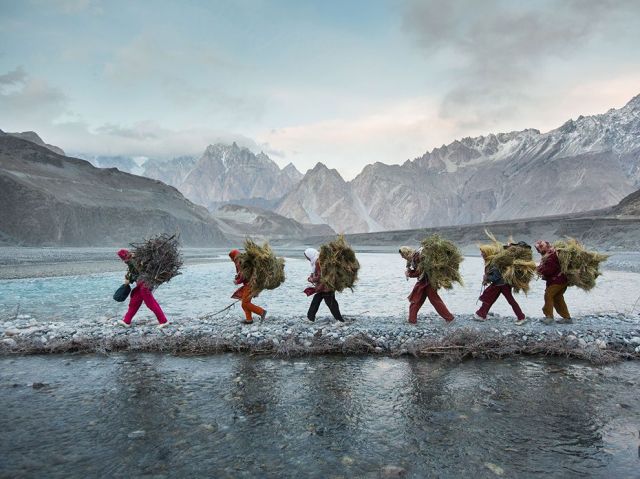
http://photography.nationalgeographic.com/photography/photo-of-the-day/wakhi-hunza-pakistan/
The trip should not take more than two days. For two days, they can each carry their share of the supplies. Two days across uneven rocky terrain, crossing the streams and rivers and gorges that stand between their village and the crags that serve as the home of the Je’ro Mebron.
“This isn’t good.”
“I won’t argue.”
“I’m saying it’s almost sundown. We’re at least four hours away.”
“I understand that.”
The two women at the front of the small troupe banter without raising their voices. They are the most experienced at making the run for nest supplies, in the best shape, and therefore are the only two with enough energy to march and speak at the same time. Behind them, the other four women gamely process on, one foot in front of the other, none willing to be she who falls behind.
“Two days. The trip can’t take more than two days.” The woman second in line cannot contain her nerves. She’s made the run ten times over the last six years. She’s never breached the two day deadline.
“It normally doesn’t.” The leader shrugs, and her tone isn’t nearly as strained. “We got waylaid.”
“The river floods so rarely this high up,” the second notes, frustrated and anxious.
“Can’t control the weather. We crossed this bridge as soon as we could.”
“I don’t think we can reason with the males if they catch us,” the second replies. “They’ll see their nests on our backs, and that’ll be that.”
“Then let’s make sure they don’t catch us.” Her calm voice helps ease, if only somewhat, the very real concern the other women feel. Still, they know better than to relax entirely.
This route has been tread by the women of the mountains for centuries. Ever since the partnership with the females of the Je’ro Mebron was first struck. Tales of how the deal first came into being vary with the storyteller. And of course each village lays claim to having been the original peacemaker.
“Let’s clear off from here as fast as possible,” the second woman says, pointing to the other side of the river. “That’s the Hunter’s Grave.”
“Yeah,” the leader responds and increases her speed across the loose stone bridge that spans the slow-moving river.
These women know their old legend by heart. At least, they know the version told by their elders each year in the ceremony held before they set off for the nests of the Ne’ro Mebron.
The story was one of mutual need. One of the village’s men, an arrogant hunter, had claimed he could track, capture and kill one of the Je’ro Mebron that live on the far side of the mountains. Gigantic eagles, the Je’ro Mebron live at the mountain’s furthest eastern edge, overlooking the foothills and dense forest below. In all their history, the people of the mountain had seen no reason to attempt to encounter one of these eagles on purpose, let alone seek one out to hunt.
But this hunter was boastful, and he’d said he could do it. As these things go, he was eventually convinced to prove himself. So he took his slingshot and a pack and began the trek east. Hunting the Je’ro Mebron wasn’t necessarily sacrilegious, or against any custom. It was, put simply, incredibly stupid. The village elders, quietly so as to not alarm anyone, began making arrangements for his funeral only an hour after he left.
Not quietly enough. The hunter’s wife, who’d counseled against his going on the foolish errand in the first place, overheard the elders discussing plans for a burial. It was a sticky task, given how unlikely it was there would be any of his body left to put in the ground. She left straight away, intending to drag her prideful husband back.
Only a few hours from the village, the hunter paused at the first big river crossing. He drank what water remained in his supplies and refilled from the river. He never saw the shadow move down the cliff behind him, never heard the soft swish of the bird’s feathers. He only realized he was not alone when he saw one such feather fall beside him, a black so deep and total that the color was said to be a gift from Death himself to the very first mountain eagle.
The female eagle was on him a second later. She pinned him to the rocks, his body immobile between her long, sharp talons.
“You’re coming to steal and eat my children,” the Je’ro Mebron accused the hunter.
“No!” the man replied, truthfully. “I’m coming to hunt you. Well, maybe not you specifically, but any fully grown Je’ro Mebron.”
“Liar!” the eagle let loose a booming shriek. “All males kill our children. It is their way.” She would have killed the hunter then if the man’s wife hadn’t arrived just in time.
“Wait! Don’t kill him!” his wife cried, pleading.
The eagle turned toward her, head tilted, a single intelligent eye boring into the wife. She took stock, but wasn’t ready to be swayed.
“Why should I not kill him? He seeks to kill my children and eat them.”
“No he doesn’t,” the wife replied. “He’s just a stupid man who claimed he could kill one of the Je’ro Mebron. A magnificent, beautiful one such as yourself. Killing a baby eagle would do nothing for his foolish pride.”
“Is that so?” The eagle looked from the wife to the man at her mercy, then his wife, then back one last time. “Well that’s alright then. Up you go.” And she lifted her talons and took an elegant hop backward.
“That’s… alright?” the man said, not moving, suspecting a trap.
“Sure. It’s all fair between us adults, but the hunting of children goes too far. And our males find the taste of each other’s children quite impossible to ignore.”
“Your men eat your children?” the wife gasped and covered her mouth. “How awful!”
“Yes, it is that,” the eagle answered and bowed her head in sadness. “We must hide them until they’re too big to eat. Almost one year.”
The wife shook her head in horror. Just then, a cold wind blew across the river, and the wife shivered violently. The eagle could not help but notice.
“Are you alright?” she asked the wife.
“Yes, now that you’ll let my husband live.”
“Of course. He’s a fool thinking he could kill me. I mean, look at how small he is, and how big and strong and fast I am.”
“Now that I see you up close,” the hunter admitted, finally uncovering the courage to sit up, “I don’t see how my slingshot could possibly do you much harm.”
“Indeed. But thinking you might be able to kill me is no crime. Just stupid.” She turned back to the wife. “But that’s not what I mean. You’re shivering.”
The wife nodded. “The cold months approach, and our huts do not offer much warmth.”
With a thoughtful look in her sharp eyes, the eagle tapped her massive talons on the rocky ground. She looked back to the east, toward her home, and then to the west and the villages of the mountain people.
“Perhaps we can help each other,” she said. “Our nests are very warm. We carry the materials from the foothills and the forest, weave them together to withstand cold and rain and snow.”
“That does sound handy,” the wife said.
“If I teach you the secret to nest building, your small and frail bodies would be far more comfortable in the cold months. And in exchange, you could take our children. They would be safe, way out west with you, at least until they grow too big for our men to eat them.”
The hunter and the wife looked each other. All things considered, it seems wise to have this creature on their side rather than not, so they agreed. And with that, the deal between the people of the mountains and the Je’ro Mebron came into existence.
The eagle was good on her word. She went back to the village and taught the people how to build nests that perfectly blocked the worst of the cold. And for their part, the people all agreed that the exchange was fair and welcomed the eagle young.
Once a year, the exchange was made. The women of the Je’ro Mebron would send the nest materials back with the women of the village, and hide their babies in among the twigs and sticks and moss. But they were very clear with the women on the need for haste.
“Our men will know something is wrong when they return from their hunts and do not hear the cries of our children,” the eagles would warn. “They return from the hunt two days after the eggs hatch. And when they know something is wrong, they will set out to find the children. They must be safely tucked into your nest-homes by then.”
The six women reach the far side of the river and continue apace toward home. Silently, each recalls the old legend, remembering the kindness of the female eagle. They wonder what would happen if the age-old deal was broken.
“Hang on,” the second woman says to the leader. “The hunter didn’t die here. Why’s it called Hunter’s Grave?”
“I think he did die here, but later on, in an unrelated incident.”
“That’s pretty misleading.”
“Yes, but that’s the least of our worries,” the leader reminds her.
“Because of the giant angry eagles chasing us hoping to eat their own children?”
“Yeah.”
The six women, minds and legs tired in equal measure, soldier on across the barren land. And still they replay the legend in their heads. None dares to ask out loud the question all six ask themselves, silently, each time they restart the story.
What happens to them if they become the next part of the tale?
 The Tall Tale Year