
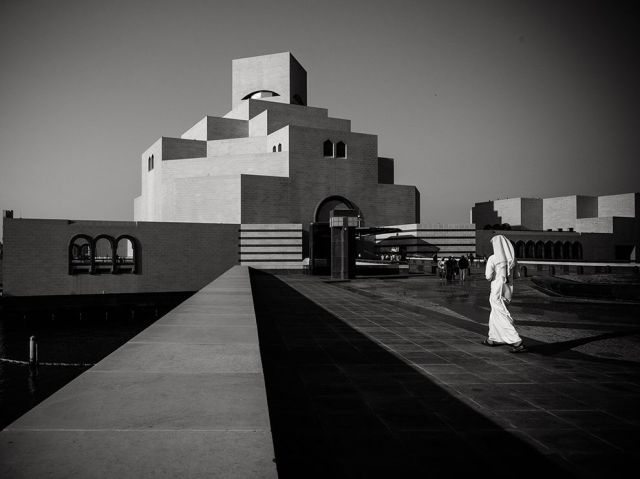
http://photography.nationalgeographic.com/photography/photo-of-the-day/architecture-art-doha-qatar/
A Cathedral of Architecture
by C. Cibo
5th Makon 1342 A.A.
Sister Emee doesn’t tolerate being late. Fifteen minutes before her meeting with a few worshippers from a provincial church social group, she glides across the dark, precise flagstones in the square. With a voice surprising loud and full for a woman of such a slight frame, she’s an ideal tour guide. When she’d moved into the clergy apartments on the square’s far side, she’d been excited about the quick commute. The apartments border the square’s northern edge.
“I traveled the provinces for years, when I first pledged myself,” she said. “So being settled is nice. And I can see my place of work as soon as I step out my front door!”
But it takes longer than she’d expected. She crosses the square in no more than two minutes, but the crowds that pile around the entrance delay her. They delay everyone.
“It’s so encouraging to see the faithful come to visit us, to see the heart of the Church’s operation in this country.” She smiled and shrugged. “If that means I have to wade through crowds when I start my day, so be it.”
The crowds are typical. On this Thursday, a typical sun-drenched day in the capital, a few hundred people mill around the large rounded-arch entrance. Most are tourists with cameras slung around their necks. Children screech, parents admonish, and people from every corner of our nation marvel. For those making their first trip to the capital, this is often the culmination of sustained surprise. The size of the buildings in the capital always impress first-timers.
“I think I was prepared for the size of the building itself,” an older man named Rog remarked when asked about the scale of the building. “But the arch… I didn’t know they could make them that tall. It’s wonderful.”
This reaction is typical at the Holy House, the Church’s new headquarters in the capital city’s center. The building is massive, its design is singular, and it’s not uncommon to hear gasps from tourists setting eyes on it for the first time. For a crowd full of believers, there are an awful lot of faces painted in joyful disbelief.
Four years ago, the Church had outgrown its long-time headquarters on Sanctus Hill. The chapel there had been home to the first archbishop of the city. In 981, just a few years after its construction, it withstood the triple earthquakes that destroyed all of its contemporary buildings. Shortly thereafter, the Church decided to make the little church on the hill the center of its national operations. It must have presented a striking sight then, a lone church perched atop a hill. The only other buildings still standing in the city center were those of the Ancients, built a millennia earlier to withstand earthquakes sent by their vengeful pagan deities. Most structures built in that era took fewer precautions, the architects spending more money and resources on flourishes and sculptures than stout structural bases.
In the ensuing centuries, the Church’s influence grew apace. The land known to that point as the Vast East was being settled faster than anyone imagined, and the Church became a major player in land ownership.
“We always thought it was ironic,” said Iyke Daug, professor of history at Kayn University in the capital. “The Church positioned itself as the country’s biggest landowner, rivaled only by the government itself, and yet its headquarters were run out of a tiny chapel and what amounted to a 4-room schoolhouse.”
In truth, the Church had outgrown the space long ago. But it wasn’t until recently that it reached a breaking point. Papers were being stored at various other locations across the city. Files were routinely lost or misplaced amid shelves held together by rusted nails and the prayers of the clergy who worked in their creaking shadows.
“Oh, it was terrifying,” Sister Emee said when a tourist asked about working at the old chapel. “We shared a desk in the old narthex. It was directly between two floor-to-ceiling shelving units, both full to bursting. We had to climb over the desk to get to the chair. One wrong move, one stray arm or leg to the wrong spot on the shelves, and the whole thing would have come tumbling down on top of us.”
The problem with expansion was two-fold. For one, the Church had no desire to tear down the old chapel and the attached offices. Nor could they have legally done so even if they had wanted to. It’s been a protected building for almost a hundred years, covered by the Preservation of the Capital and the Work of the Ancients Act of 1268. Tearing down the old chapel would have run the administrative officials of the Church afoul of the government and the faithful.
With construction on Sanctus Hill a nonstarter, the Church ran into its second problem. The government owned every piece of land adjacent to the small church. Much of it was redone after the earthquakes, and the buildings had fast become a symbol of the country’s resilience. They were designed, built, and populated in less than two years after the great tremors laid waste to the eons-old seat of power. So expansion nearby was out as well.
Strangely, despite years of tension between the Church and the national government, it was the Senate’s leadership that proposed the current location. The land was at the very edge of what could reasonably be called the City Center. A block or two more would be undeniably in West City, historically industrial and not particularly attractive to the clergy administration. But the Senate proposed a spot safely on the preferred side of that demarcation.
“We’d just heard about the discovery of the plans,” Maxeel Aysin said. Aysin is a spokesperson for the Senate and was, at the time, assigned to the Capital Liaison Committee which handles affairs between the city officials and the national government. “And we’d been kicking around the idea of offering some land the government owned in the city that wasn’t being used to its best effect. It was a serendipitous match.”
The Plans, referred to by most of the clergy with two capitalized letters, are old blueprints that became the basis of the architect’s eventual design. During a routine file dump at the old Sanctus Hill HQ, an aide to the archbishop came across a misfiled document of church designs. The designs were old, ranging from 100 to 250 years old, and they were mostly flights of fancy. Many were submitted by well-known architects to the Church, attempting to put themselves in the good graces of the bishops. But the boxy, futuristic design dated nearly 120 years ago struck the aide. He brought it, and the others, to the archbishop’s attention.
“He called me into his office,” Sister Emee recalled, “With a shout so loud I was sure he was on fire. ‘Look at this,” he told me. “This is our headquarters. Our new home. A Holy House.’ Right there in his office, two minutes after first seeing the old drawings, and he’d already named the place.”
The architect who’d submitted the design was a young woman named Sesha Litbelac. She’d shown promise in her younger years, winning a design contest while at university and being given roles on a few impressive city structures further north in the financial districts. She peaked when she was selected by Bull Rose to design their new capital offices.
Unfortunately, her career immediately began to decline. The Bull Rose offices were plagued by construction issues, many attributed to the fickle, oddball founder of the company known only as Direk. The project was eventually finished, but years later and way over budget. Litbelac’s reputation took a tumble, and she never received another individual design credit for the rest of her career.
It’s thought that her geometric plans for a dark, moody, utterly massive church were done late in her life in a last-ditch attempt to cement her legacy in the city’s skyline. With the technology of the time, it would have been a truly incredible feat to build. Perhaps impossible. The plans vanished into the old chapel on the hill, and she must have felt that bitter sting of one last failure. She could not have known this particular shortfall would prove to be temporary.
A few different architecture firms were contracted to adjust the old, obsolete designs. Eventually, Teys & Hauk had their updated design selected as it stayed the most loyal to Litbelac’s original plans. The government was uncharacteristically efficient in selling the land to the church, and the shovels broke ground almost a year to the day after the plans emerged from the old chapel’s depths.
Just over three years later, it’s the city’s latest, and perhaps most popular, tourist destination. With all the news lately about the Church’s guarded attitude, it’s opaque operations, and especially the very public financial issues it’s had in the last year (editor’s note: the third wave of arrests stemming from last year’s North Congregation embezzlement scandal were announced after this article filed), the archbishop was adamant the design be open & tourists be encouraged to visit.
And visit they do. In droves. From open to close, they march in through the huge arched entry, heads back, mouths agape. Their cameras click, and the Oohs and Ahs reverberate around the enormous atrium that is almost 90% of the building’s interior. It’s hard to explain to those who have not yet seen it in person, but the interior of the Holy House is essentially one room reaching from the beautiful, frescoed floor to the squared-off central roof far above.
That open design has had the PR effect the archbishop intended. The visitors are overwhelmingly positive, both in attitude and in reviews. But the productivity of the Church’s administrative staff has suffered. They’d hoped, with the new, larger space and the expansion of the hired staff by nearly 50%, that they would finally be able to stretch their proverbial wings. That idealized world has not, to this point, quite rounded into form.
“We have missed some things with all the noise and traffic,” an aide admitted. “We had some trouble with a referendum on grazing last week. The government ended up getting their way because we simply couldn’t get prepared in time while working around all the distractions in the Holy House.”
“They’ll get it, I’m sure,” Aysin said with a wry smile. “It is a nice building, even with that cavernous, open design. I do wonder how that mad old architect ever thought it would suit quiet contemplation.”
 The Tall Tale Year