
http://photography.nationalgeographic.com/photography/photo-of-the-day/romania-ursul-bear-dance/
Civility in Short Supply During Anti-Ursid Demonstrations
By C. Cibo
16th Mursir 1342 A.A.
For the third straight day, demonstrations against the world’s Ursid population went into the night in cities around the world.
Police in Seattle, WA and Portland, OR made several arrests amid a fresh round of effigy burning and slogan chanting. A few fires near the famous Seattle fish market spread to nearby structures, including two newspaper kiosks. The organizers were arrested for arson and inciting a riot.
In Europe, the stories are similar. Warsaw, Budapest and Vienna saw hundreds gather in public places to rail against the Ursids in the region. London and Paris both had smaller, but still vocal, gatherings.
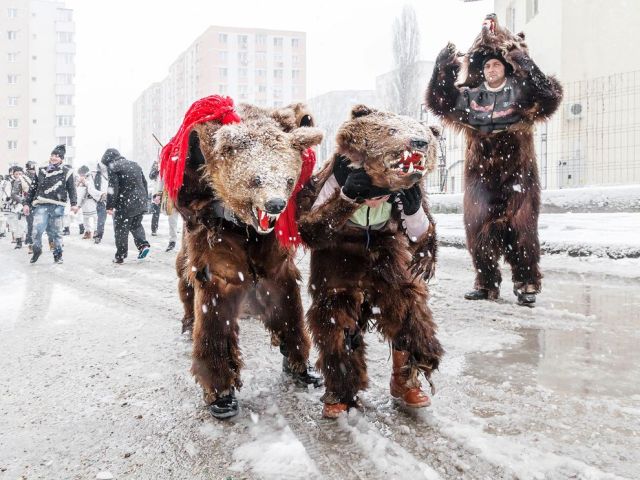
One such demonstration saw a few young men dressed in bear costumes miming quadrupedal walking. Ursids evolved from a common ancestor with bears, and the image of Ursids walking on all four understood to be highly offensive.
“We are in favor of the people assembling and voicing their opinions as is their right,” said a senior aide in the Budapest mayor’s office who wished to remain anonymous. “But none of us agree with these particular opinions. We’re never going to make progress with such a hateful attitude.”
This latest round of demonstrations sparked a week ago in Vienna. Global talks were organized to discuss the preservation and restoration of the world’s fresh- and saltwater fisheries. Key diplomats from nearly three dozen countries were present, including Japan and Norway who have been accused for years of neglecting international fishing regulations.
While not necessarily a biological necessity, eating fish is a major part of Ursid culture in most of their populations around the world. Their representatives at the talks were sent with a very specific agenda to avoid giving away too many fishing rights in their territories.
This does not sit well with far-left groups, especially the newly reformed Weathermen, a group still recognized as terrorists by most of the civilized world.
Tensions had run high for the first few days of meetings, but Austrian police and military reserve forces kept the demonstrations relatively safe. That peace did not last.
On the third night, an altercation flared up outside the Hotel Imperial between a group of demonstrators and two members of an Ursid diplomat’s security detail. Accounts differ on what started the trouble, but it ended with three demonstrators getting rushed to the hospital with severe lacerations. One required a blood transfusion as a result of the wounds she sustained.
Both Ursids were also injured in the fracas but were treated by EMTs on site. They released on the condition that they remain inside the hotel until police instruct them otherwise.
According to the police report, a large group of demonstrators verbally threatened the two Ursids as they attempted to leave the hotel. While attempting to get through the group, glass bottles were thrown, one of which broke over an Ursid’s shoulder. Things escalated from there.
Around the world, the response has been loud and vitriolic. The Ursid population and their supporters are fed up with what they perceive to be archaic and racist attitudes.
“Ursids live by the same laws as the rest of us,” said T. J. Roades, a professor of ethics at Dickenson College who is a vocal Ursid supporter. “They negotiate in the same government houses, pay the same taxes and attend the same schools. How is it the 21st century and we’re still running back the same tired racism that’s gotten us nowhere for literally our entire existence?”
The demonstrations have made for strange bedfellows. In the Pacific Northwest of the United States, two groups that are often diametrically opposed have been found demonstrating side by side. Far-left environmentalists who believe the Ursid population is a major player in overfishing around the world chanted just half a block from a far-right group called Human Rights.
“They aren’t humans,” a member of the Human Rights group said. “And shouldn’t be protected by the same laws as us. Especially when they only follow the ones they want to.”
“That kind of wildly inaccurate, close-minded complaint is typical of these groups,” said Baalo Kodaiaka, former Director of the Ursid Cultural Exchange in the US Department of Health and Human Services. “They see something different and they ascribe pre-fabricated, unrelated hatred to what they believe is an easy target.”
Kodaiaka has been in Vienna all week advising both the Ursid contingent and the US State Department’s staff that have come to participate in the talks.
“I think it says a lot about these extremists groups that they are so far beyond reason, curved so far to the left and the right that they’ve managed to meet each other in the middle on the other side of sanity,” he continued. “Ursid populations are as concerned about the future environmental health of our planet as humans. Anyone who tells you otherwise is lying.”
Demonstrations are growing smaller by the day, and police in Vienna and around the world hope to see them cool off entirely over the next 48 hours. The fishing talks are scheduled to end on Friday afternoon, but another environmental meeting is scheduled at the United Nation’s New York headquarters next month.
“We’ll be prepared,” an NYPD spokesperson said this morning in response to a question regarding their preparations for the UN meetings. “Barricades, extra officers on duty, all the usual requirements will be in place. This isn’t our first rodeo.”
 The Tall Tale Year