
http://photography.nationalgeographic.com/photography/photo-of-the-day/do-fishing-craft-vietnam/
In ages past, the Voken harvest was the spring’s second major festival after the celebration of the seed planting. The entire town would turn out shortly after dawn exactly one week after the seeds went into the ground. Kids would bustle about, making a game of spotting the tan and brown husks. With groggy parents in tow, children would dash from house to house in a frantic search. Behind them, mom or dad would gently cut down the stiff cocoon and toss it into their basket. Most clung to the bamboo gutters that lined the houses in town, but occasionally they would turn up in the temple rafters or under a tent in the market.
Once the town was deemed cleared, there would be a parade across the road and into the flowering field. A long line of trees marked the border of the town’s influence, and untamed wild filled the world beyond. With care, the families would tie up the Voken under sturdy branches. The temple Lord normally made a stirring speech, and anyone so inclined shared a glass of wine to commemorate the moment. Through the spring, the townsfolk shared the duty of checking up on the cocoons. It was considered a very ill omen to allow them to hatch early, and great steps were taken to ensure they remained sealed until the solstice.
But ages pass. Over the years, the world beyond the tree line became less wild. The outside world encroached rarely, then occasionally, then frequently. Children grew up and left and did not return to the little town except for the year-end festivals or to bury their parents. Less people meant more duties in the fields meant less time for old traditions. The older folk carried on the Voken festival as a matter of principle, but it became a joyless chore when less and less of the town rose with the sun on the appointed day.
By the time of his youth, Chanusau lived in a town that understood the Voken festival as little more than a distant memory. His father was the last traditionalist. It was left to both of them to comb the town each year, gather up the Voken and repurpose them to the distant line of trees. Even then, it wasn’t the same ritual. Once, those trees were the border of civilization and the world beyond. Untended meadows and forests sprawled just out of the trees’ reach. It was the ideal gateway for when the Voken hatched on the summer solstice. By the time he was old enough to tie up Voken without his father’s hand spotting him, Chanusau could look from the trees out across endless farmland, criss-crossed with the unnatural straight lines of new roads.
When his father passed away, Chanusau made an attempt to recruit others to the old cause. It was with sorrow that they declined.
“We are too busy, my friend.”
“It’s a lovely idea, Chanusau, but we haven’t the time.”
“My father would be proud of you, Chanusau, surely he would. But he taught me I must work for I have my own children to feed. I am sorry, truly.”
Chanusau understood their dilemma. He and his wife had desired children, but that particular gift was not written into their stars. Instead, they took up tasks around the village; they maintained the temple, cleaned pots and pans, babysat when parents needed a helping hand. They were well-liked and respected. Eventually, the disappointment in their hearts was replaced with affection for those around them. The tended to the people of the town as they could not tend their own children, and it was as good a substitute as they could have asked for.
Each spring, Chanusau undertook the monumental task of harvesting the Voken. What used to take a morning now took him the whole day. Each year, he would return well after dark, sweating and sore but filled with enormous pride. These were his people to tend, and that tending included the Voken. In fact required it, as his father had taught him and as he had always believed.
He and his wife grew old, and so too did the town around them. Children continued to grow up and leave. Others came to stay, former city dwellers seeking something that could be found in the country soil that did not exist in their former concrete world. But those going out always outnumbered those coming in. By the time his wife died, Chanusau lived in a town half the size of the one into which he was born so many years before.
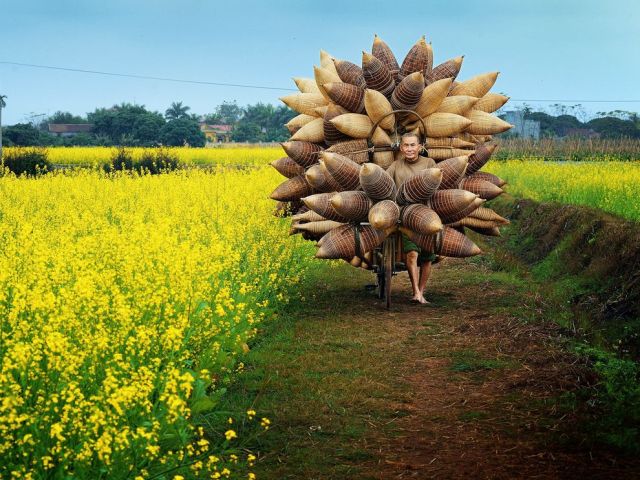
There was no excuse for shirking duty, though, and perhaps this year more than ever. Exactly one week after the spring planting, Chanusau stepped outside with the rising of the sun as he had for decades. He gathered up the Voken throughout the morning and into the afternoon. One of the town’s young mothers had plied him with lunch and water to help him keep up his strength. Thus fortified, he pushed his Voken-laden bike out of town. The walk through the flowering field was slow. He did not want to lose time to a fall and the subsequent re-gathering of strewn cocoons.
He worked through the remaining daylight hours stringing up the Voken into the trees at the border of what had not been untamed wild for a very long time. Chanusau felt some measure of sadness at this fact, but less than his father had felt. Even as a boy, Chanusau could see farmland beyond these trees. But in his father’s lifetime, as the man often lamented, the wild land had been tamed. Chanusau, however hard he tried, could never quite summon that same mournful air. How could he fully comprehend the loss of something he only partially understood?
He thought about this as the sun set. He was old now, and no longer buttressed by his steady wife. The Voken festival work was exhausting, and he felt this was very likely his last year on the job. Next year, he realized, no one would collect the cocoons, and when summer came these trees would be strangely bereft of their tan and brown charges. Once he was gone, there would remain only those townsfolk who remembered his dedication to the Voken and the old tradition. They would be sad for its loss, but not overly sad. How could they fully comprehend the loss of something they only partially understood?
Eventually he completed his task. Weary and stiff, he slowly padded back across the field toward home. He took out a glass and poured a small measure of wine. Out on his porch, he lifted it to the empty rocking chair beside his own, to the empty street past that and, well beyond, to the empty fields that surrounded the town.
The months went by faster than he would have liked. Spring burned off into the heat of summer. Before he was entirely ready for it, the solstice had arrived.
It was the last rite of the old tradition that anyone would ever observe. Chanusau put on his tan sweater, the one his wife always said was her favorite on him, and he set out for the ancient line of trees. He walked with no urgency, content to a let the warm night drape itself around him.
He arrived in the midst of full twilight. The dark shadows rustled beneath the branches with a noticeable restlessness. Chanusau stood quietly and waited for the show to begin.
Soon, the first soft crack resounded from the trees. A little strip of light peeked out from inside the cocoon. Soon, more cracks followed paired with more splashes of light. Within minutes, there was a gentle symphony of cracking, splitting, tearing as the Voken gave birth.
Wisps of soft light sped from the split cocoons. At once solid and ethereal, they looked like snakes that struggled to maintain their long, slender form. Some tended toward a blob, while others were slender enough to resemble an iridescent string. Yet all were made from a healthy white light.
Chanusau could not pick her out of the crowd. He had known that would not be possible. In all his years tending the Voken, it was never possible to identify individuals. Every time someone from the town died, his or her soul returned to their place of birth. Even all those children who had left decades before and had grown old and died did not stay away forever. Eventually, they all returned and formed the tan and brown Voken in the early spring. The festival had grown to celebrate their lives and wish them well on their journey to whatever came next. The harvest had been a group effort for a reason – no one knew which cocoon held their grandfather or their mother or their best friend. So they performed the ritual together back when they understood what it meant, or maybe back when it actually meant something.
Chanusau did not cry as the air around him filled with the swirl of glowing souls. His eyes darted left and right in a daring attempt to set his gaze on each. He did not know which was her, and he wanted to see her one last time before she was gone forever. It took a great deal of concentration which explained why he did not hear them coming.
A hand set down gently on his shoulder, and Chanusau nearly jumped out of his skin. He spun to see the temple Lord, a man even older than himself. And behind him, barely lit faces turned up in wonder. The whole town had followed this one last time.
Just then, strips of light began to leave the safety of the trees. They flitted out in twos and threes at first, and then by the dozens. They spilled out into the part of the world that was, not so long ago, a place of untamed wild.
From the pack, a single iridescent strip veered off course. It swirled over the heads of the townsfolk, dousing their faces in a beautiful dance of light and shadow. With what the temple Lord would later call “a heartfelt purpose,” the strip made a beeline for Chanusau. It twirled around his torso once, across his face with a touch that felt like something words could never hope to accurately describe. And then it was gone, meandering out past the trees, on to whatever it is that calls to the dead.
For a long time, no one said anything. They watched as the lights danced over the fields, getting smaller and dimmer as they moved further away.
The temple Lord motioned someone behind him, and a young man brought out a bottle of wine and a stack of cups. The young man poured two cups and handed them over. Then he walked backward to distribute to the others.
“Why did you come?” Chanusau asked when finally he trusted himself to speak.
The temple Lord smiled and lifted his cup. “To say goodbye.”
 The Tall Tale Year