
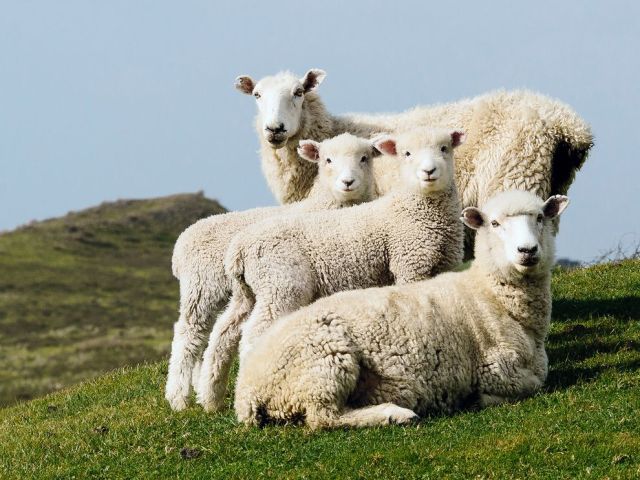
http://photography.nationalgeographic.com/photography/photo-of-the-day/sheep-portrait-new-zealand/
Encyclopedia Fauna – S
Entry 14.1 – Apparition Sheep
Scientific name: Ovis Aries Polyphemus
Synopsis: A subspecies of the standard domesticated sheep, the Apparition Sheep is not a breed of the standard ovis aries despite a great deal of debate in the 20th century on the subject. The advent and application of genetic sequencing has unequivocally proven the Apparition Sheep are their own subspecies, dubbed ovis aries polyphemus by Dr. M.G. Venit who ran the initial genome sequencing.
Their evolutionary history, diet, individual and flock behavior as well as their reproductive patterns are nearly identical to their parent species, ovis aries, and will not be repeated here. You can refer to the previous entry (S-14) for that information.
The subspecies evolved on certain Mediterranean islands. It’s original arrival on these islands is likely a result of either human or Cyclope activities in the area.
It is impossible to discuss the species without first discussing the uses of its wool. For millennia, its wool has been used to weave invisibility cloaks. A great number of studies have been done on both the sheep themselves and the sheared wool. To date, there has not yet been any scientifically significant conclusion as to how the wool provides invisibility.
The process, however, is very specific. The sheep must be raised on an island in the Ionian Sea. Many have tried to rear the sheep in other parts of the Aegean, Mediterranean, and all over the world. The sheep survive without trouble, but the resulting wool loses whatever property it is that renders its wearer unseeable.
Sheep raised on the proper islands must be sheared on days of celestial significance (a solstice, equinox, harvest moon, eclipse and so forth). A cloak can only be made from the sheared wool from a single sheep harvested on the same celestially significant day. So, if a farmer shears a female named Dolly on the summer solstice, he can only weave the cloak from wool sheared from Dolly on the summer solstice. For this reason, it can sometimes take years to harvest enough wool to create a cloak large enough to be effective for an adult.
Yet that is not the strangest part. Only the hands that sheared the sheep can work the wool to create the cloak. Specialization is, for whatever reason, anathema to the invisibility effect. For this reason, most apparition sheep farms are small, privately owned, and incredibly lucrative.
There is a comprehensive disconnect between the disposition of the sheep themselves and the resulting effect of their wool. Pockets of the subspecies are still raised and sheared all over the world, and the wool is considered desirable even without its invisibility effect. It seems that the wool’s power is related to circumstances around the sheep, rather than the health or well-being of the beast itself.
Everyone knows the legend related in Homer’s epic poem The Odyssey regarding Odysseus’ adventures after the Trojan War. Unverifiable claims by a Rockefeller University study date the events of the poem to the 12th century BCE. Ignoring the amount of truth applied to Homer’s work, we know unequivocally that the Cyclopes people died out in the middle of the 7th century BCE. At that time, they had been tending the Apparition Sheep for generations. A conservative guess is that these particular sheep, still genetically identical to today’s subspecies, were domesticated from at least the 8th century BCE.
Habitat: Islands of the Ionian Sea. Chiefly Sicily, though populations are raised on Malta & Victoria, Lefkas, Kefalonia, Zakinthos, and Corfu. Ironically, no Apparition Sheep remain on Ithaka.
Further Reading: There are any number of books on the subject of the Apparition Sheep and the related invisibility cloaks. We recommend Peter Wallace’s excellent account of modern Apparition Sheep husbandry, You Can’t See Me. For a good read on the business of the invisibility cloaks made from the species’ wool, try Lost Not Found: Invisibility Cloaks and the Law of Liability in the 20th Century which is, we assure you, much more riveting than its title might suggest.
 The Tall Tale Year