
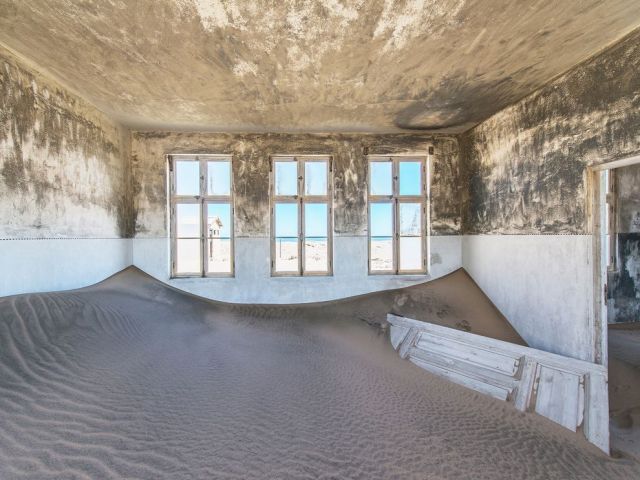
On her first trip to the house, she had brought nothing and, to her dismay, found nothing. She felt betrayed. Her information had come from reliable sources. She’d done her due diligence and confirmed from two sources; one human, one not. Both had supplied her with the same location. Surely, this must be the place.
And yet here was a house abandoned. Sand rolled through the emptied rooms. Some doors were missing, perhaps carried off by looters. Others sat half buried in the sand in an analog of her current plan that she felt was discomfitingly accurate. With care, she searched the house. She walked outside, and found a long pole in a nearby shed. She returned to the house and poked down into the sand in the living room corner, under the foyer’s dangling, rusted chandelier, even into the drifts that had filled the open oven.
There was nothing there. It was a house full of sand and, she thought bitterly as she left, of disappointment.
On her second trip to the house, some days later, she had abandoned the pole in favor of a jar. Pouting had done her no good after the failed first trip, but she felt more confident on the follow up. It was a much shorter stay. She unscrewed the lid from the jar, dipped it into the living room drift and dug out one serving of sand. She twirled the lid back on and, without a look back, exited the house.
The third trip was make or break. She’d spent exactly as much time in the desert as she was comfortable spending. Either she had solved the riddle, and would soon find herself on the cusp of preliminary success, or she had not and would leave empty-handed.
For this trip, she had neither a pole nor a jar. Instead, she carried an oblong leather case. She undid the clasps and extracted a pair of eyeglasses. The lenses had been forged from the very sand on which she now stood. The same sand she scooped into her jar on her previous visit.
Under her breath, she whispered something halfway between a prayer and a demand to whoever might be listening. Then she slipped on the eyeglasses and looked around.
The room was no longer an empty, abandoned place. There was no longer any sand. Instead, she saw a tidy living room with a coffee table, two easy chairs, and a small bookshelf by the corner that was bursting with old, leather-bound tomes. Many had gilded letters in no language she could recognize.
Most importantly, the room held a homeowner. He was a Fanak, one of the small desert people with extra-large ears and small, dark eyes designed to see well in the blaze of day and the dead of night. Also, he looked pretty pissed.
“Why are you in my house?” he asked.
“It looked abandoned.”
“She says with glasses on her face specially made to see through my mirage.”
“Yeah I… didn’t really think that answer through,” she finished lamely.
The Fanak sighed and shook his head. “Clever enough to figure out the glasses. Dense enough to be otherwise unprepared. How charming.” He pointed one of the chairs. “Sit down. I’ve got iced mint tea in the fridge.”
He disappeared into the other room. She sat down on the chair gingerly, unsure if it would turn to sand beneath her. But no, it was just like any other chair. She lifted the glasses – sand everywhere, no sign of life. Glasses down – comfortable home. It really was some trick.
“From your perspective, the first mirages were recorded by travelers from Uruk,” the Fanak said as he returned to the room with a tea tray, carefully balancing a full pitcher, two tall glasses and a little carafe of simple syrup. “We hadn’t realized humans had evolved into a civilization yet. Three fellows walked right into a traditional mirage battle over some girl. Can’t remember her name.”
“Morgana,” the woman said in reply. “Her name was Fata Morgana.”
The Fanak smiled. “Yes, I think that’s right.” He sat, poured two teas and passed the young woman the glass.
“She left the showoffs in the desert and traveled with the Uruk scholars for three days. That was when humans first learned that the Fanak were responsible for mirages.” The young woman had done her homework before she came out here. The earlier shock of actually finding a Fanak had worn off. She was getting her sea legs, or perhaps her sand legs, under her.
“And thus our lives became forever complicated,” he answered resignedly. “So what sort of illusion do you need and, if I can pry, why do you need it?”
“An old boyfriend has something of mine,” she said. “I’d like it back.”
“Asking nicely often works.”
“Not in this case.”
“Because he’s your ex.”
“Yes,” she answered, then added, “And because we are treasure hunters after the same bounty.”
The Fanak nodded and sipped his iced tea. The cubes clinked in his glass.
“You only answered the second part of my question,” he finally said.
“What was the first?”
“What sort of illusion do you need?” he asked again.
“It doesn’t have to be overly elaborate. Just enough to pique his interest and draw him out of hiding. I need what he has.”
The Fanak shook his head. “Are you sure? It sounded before like you want the treasure you both seek.”
“He has a clue that might lead to it,” she said. “It was my clue, he pretended to like me to acquire it, and then he vamoosed.”
“So is it revenge you seek or the treasure?”
The woman threw up her arms in exasperation. “Are you a mirage-maker or my therapist?”
“I’m the guy whose house you broke into,” the Fanak admonished. “And my civilization is a thousand years older than yours. So maybe it’s worth listening to what I have to say.”
She relented. “Fair point.”
“There’s an old saying among the Fanak people. ‘No one ever sees a mirage behind them.’ It’s something we hear a lot when we’re learning our craft.” He set down his glass and moved his hand into the thin air by his knee. From nowhere, a small pile of sand appeared in his upturned palm.
“We’re taught not to create illusions to hide the past. It is effort wasted. What is already known cannot be lost. Mirages are made to veil the future, to protect something still undiscovered. We’re taught to point our effort in that direction.”
With a twist of his wrist, he poured the sand out. Halfway to the ground, it vanished. She peeked outside the lenses of her glasses to see it fall onto the mirage sand drift.
“Seems a decent enough lesson for making mirages,” she said.
“Yes, but that’s not why the lesson is taught.”
She nodded in reply and set down her drink. With a sigh, she closed her eyes and rubbed at them beneath the lenses.
“I just want to beat him to the treasure. I want it so bad I can taste it.”
“You should try some of the syrup here. It’ll even that out,” the Fanak suggested.
She dropped her hands and opened her eyes. “You know what I mean.”
“Yeah.” He finished his tea and held out his arms. “Do you still want my help?”
“I didn’t come for life lessons and refreshments,” she said as she poured a little syrup into her glass. She took a sip and nodded. “Though you weren’t kidding.”
The Fanak forged on anyway. “Find a way to use my particular skills to help you find the treasure, rather than help you stick it to your ex-boyfriend, and I think we can come to an agreement.”
“Ok,” she said. “I’ll come up with something.”
“Great,” he said. “When you come back, instead of just barging in, maybe knock. Or bring some cake for the tea. I know I live in the middle of nowhere in a house half-invaded by the desert, but that’s no reason to be uncivilized.”
She laughed and felt some long-twisted tension ease somewhere inside her. For a moment, she prepared to lament the strange way this whole affair had unfolded, but then she remembered the old Fanak saying. And instead, she let her mind begin to formulate her next steps. Much like a mirage, no one finds treasure behind him. That bright red X on the map is always ahead, just around the next turn.
Assuming, of course, the turn is real and not some trick of the light created by a big-eared, tea-loving wanna-be sage.
 The Tall Tale Year