
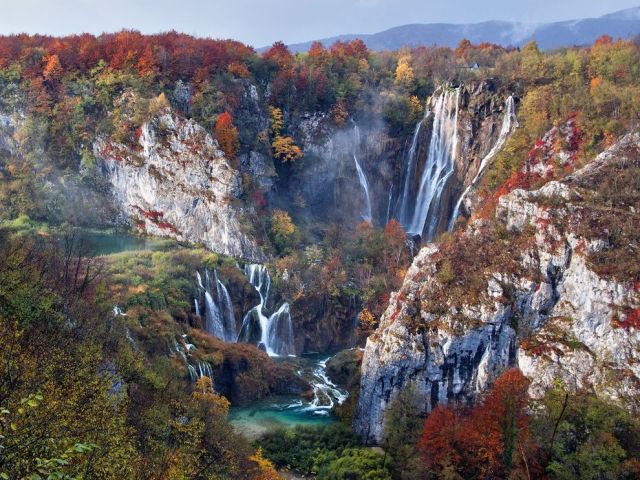
Six weeks. Four limited-AI drones, five camp sites, and two close calls with local megafauna. The bear-like thing with the projectile claws had been easy enough to dispatch. The giant worm had not been, and they’d lost a drone and almost a hundred pounds of food in their escape. That aside, the reviews were coming in and they were glowing.
The beauty of a garden planet where it was always autumn was as breathtaking as they’d anticipated. Polychromatic trees filled every inch of landscape. The whole world bloomed in rich earth tones – browns and tans swirled with orange and yellow and a dozen shades of red. Rivers meandered through forests that the most idealistic, fantastical landscape artists on Earth wouldn’t dream of painting.
The last three days found the two partners hiking through craggy foothills. Every day their definition of beauty expanded as the world they traversed showed them new and glorious wonders.
“Everything we saw for six weeks,” a fit, young woman said to her partner. She easily bounded over the exposed grey rock, gleefully splashed through the cold, clear water of myriad streams. Her partner, a male not much older than her but less athletic, breathed heavily as he attempted to keep up. “All the information from the exploratory drone missions over eighteen months. Photographs and videos that number in the tens of thousands. All of it was clear – Octobria is uninhabited.”
“It is uninhabited,” the man said.
She stopped and turned back to him. His head was down, eyes locked on the slick ground to keep his feet. The prophecy nearly self-fulfilled when he bumped into her and almost went into a small plateau lake.
“Are you… you’re serious?”
“Did you see that? I almost fell there.” He was distracted, and his head stayed down as he planned his next steps along the heights.
Clara shook her head. “Did I see… you can’t be serious, Merritt.”
“I am. Did you see how close I was to doing a jackknife one and a half into that lake?” He peered at the beautiful little lake with a look of suspicion.
“You’re telling me you’re convinced this planet is uninhabited.”
“I am.”
“Ok,” she said. She pointed to the waterfalls on the opposite ridge. A few streams ran off the edge of the cliff, cascading down to the pools far below. “So that house is a naturally occurring feature?”
Finally, Merritt lifted his head. He followed her pointing finger. On the top of the ridge, there was a house tucked in among the colorful foliage.
“Huh,” he said. “Wonder what property taxes are like this far from a city.”
Three hours later, they had scaled the heights on their side of the falls. Hiking through the blaze of color along the ridgeline, they stood beside a stream opposite the house. The design was simple but elegant, a mid-century style as it was still called back on Earth, even though the middle of the titular century was nearly three hundred years gone.
Without warning, a door on the side of the house swung open. A woman stepped out wearing a thick grey sweater and jeans. Dark brown boots rose halfway up her thighs, and she held a steaming mug in her hand.
“You guys coffee or tea people?”
“Depends on the coffee,” Clara answered with a smirk. The woman laughed.
“I’ve got the good stuff. Come on in.” She directed them to a little bridge that crossed the stream.
Minutes later, they were installed at a long table in the woman’s sun-drenched kitchen. Wood-carved mugs sat in front of them, tendrils of steam rising from an aromatic blend that smelled heavenly after six weeks of canned coffee down quickly at lukewarm temperature over a campfire. Clara took a first sip and felt warmth and civilization slide down her throat.
“Good, right?” The woman asked when she saw a smile curl onto Clara’s lips.
“Spectacular.”
As Clara and Merritt sipped their coffee, they took a closer look at the woman. Her skin was an interesting dark shade. It wasn’t exactly tanned Caucasian skin, and she certainly wasn’t of African descent. It had an orange-tan quality that gave it a rich, healthy look. It was as if she was cut from a block of clay, her skin smoothed to an earth-tone that seamlessly blended into this planet’s ever-autumnal landscape. Clara was sure she’d seen that shade of skin before, but she couldn’t quite place it.
“It’s very kind of you to invite us into your home, but I fear my curiosity is getting the better of me.” Merritt could be very disarming when it was required. His purpose was clearly to collect intel to return to their employer. But he made it sound like a friendly neighbor merely interested in catching up.
“You want to know how I got out here, and why I live here, and for how long,” the woman said in anticipation of the question. “It must seem strange to you.”
Merritt smiled, charming as can be. “Not strange. We just hadn’t expected to meet anyone on Octobria.”
“That’s what you’re calling it?” The woman nodded and turned over the name in her mind. “That’s not bad, actually. You two are explorers?”
“In a sense,” Clara said. “Our company sends us to garden planets to do some basic research. Flora, fauna, weather, that sort of thing.”
“To what end, if I may ask?”
“It really depends on what we find,” Clara answered.
The woman smiled in a way that suggested she did not believe Clara in the slightest. Clara began to formulate a lie that would help ease the woman’s mind, but when she spoke again it wasn’t what she set out to say.
“Mostly for occupation,” she clarified. Merritt twitched beside her, but it was too late to stop his partner’s explanation without making them both look suspicious. “If we find a garden planet that’s suitable for habitation, our company wants to lobby for exclusive rights to its colonization from the international body that governs that sort of thing.”
“So what makes a garden planet suitable for occupation?” The woman said this last word as if it was a snake in her mouth, all fangs and writhing malevolence.
Merritt opened his mouth with the intention of declaring weather and topography the key factors. He was as surprised as Clara when instead he answered, “Locals.”
The woman nodded. “If there are locals, you must find a way to drive them out?”
Clara shook her head. “No, that’s not it. It’s our preference to find a place without sentient life. But if we come across people, we’re required to negotiate fair terms with them. The international body does not want the mistakes of the past repeated.”
“My people met explorers much like yourselves. This was many centuries ago. They invited them into their homes, gave them food from their fires, let them drink from their wooden mugs, told them the history of the land.” The woman sighed, and for a moment she seemed a million miles away. “In return, the explorers brought war and disease and, inevitably, death.”
“On Earth, that happened a lot,” Merritt said. “The intention was never malevolent at the start. Most early settlers wanted only to live how they chose. The wars, the unexpected plagues… all of it was horrible, yes, but inevitable. That was the unfortunate cost of doing business.”
The woman set down her mug. She stood and walked to the island in the middle of the kitchen. From behind the sugar dish, she grabbed a little bottle. She set it down on the kitchen table.
“You have each had a dose of this serum. It will give you a contagious disease. Maybe your doctors can save you, maybe they cannot. It is not of your world, it is of mine, and they may not recognize its properties with so little foreknowledge.”
“What?” Clara said with fear laced in her voice. She looked from the bottle to her mug. It had seemed so innocent. “No, that’s… you wouldn’t.”
“You would poison us, in your house, after we’d done nothing to you? What kind of witch are you?” Merritt, evidently, zoomed straight to the anger portion of his response.
“You have done nothing to me yet, but you would when your time came. Just as the settlers at Roanoke did nothing to my people, but those that followed did.” The woman spoke with quiet calm. There was a current of solemnity in her voice that, balanced with the harsh content, was extremely unsettling.
“Who are your people? Why do you keep…?” Clara’s questioned died on her lips. She knew now why the woman’s skin color looked familiar, where she had seen that polished-clay hue. In her lessons as a girl about Lost People, about those ethnicities that had been wiped from the face of the earth in the century of terror when the planet fought back against humanity.
“You can answer your partner’s questions now, I think,” the woman said when she saw recognition flood Clara’s face.
“What’s she talking about?” Merritt asked. He’d gone to an exclusive private school that, evidently, did not see value in teaching its students about what was dead and gone.
“She’s lived here not quite two hundred years,” Clara said, looking at the woman with bubbling up anger. She thought, as the stages of grief progressed she would lose the previous step, but fear never left her. Nor would it, not with poison weaving its way through her body.
“And she lives here because there are none of her kind left on Earth,” she continued. “But I have no idea how you got here before humanity discovered the mechanics of travel.”
“Two hundred years?” Merritt said in disbelief. “Even with gene therapy, with all the money in the world, she wouldn’t look so young after so long.”
“I have looked this young far longer than two hundred years,” the woman said. “And I rely on no human mechanics, travel or otherwise. My kind can flit between worlds as we wish.”
“What the hell are you?” Merritt asked, standing and slamming his fist on the table. “And who are you to play God with our lives?”
At that, the woman laughed. “Now you’re getting it.” Her laughter died, and she continued. “You have two options. You can hurry home and hope your doctors can cure you and stop the contagious nature of the disease. If they fail, you will infect everyone. Or you can send word that my planet is dangerous and to be avoided at all costs. And then die here, leaving Earth safe.”
“What kind of choice is that?” Clara practically shrieked. The reality of her impending, probably inevitable death was starting to overtake her natural resilience. “We did nothing to deserve this!”
“Ships full of influenza, of smallpox and pneumonia landed on my shores. They killed my people, and then when only a handful remained, they were marched and subjugated and eventually killed, to a man, by the actions and choices of others. They ruled a continent, and a few hundred years later they were all dead. They did nothing to deserve it.” Sadness and anger meshed in the woman’s voice. “Who could do anything to deserve that fate?”
“Give us the antidote, and we will keep our company away,” Merritt bargained. “We will keep everyone away.”
The woman shook her head and sighed. “There is no antidote. The leaf has fallen from the tree. It cannot be put back.”
Merritt was beside himself with rage. He stepped around the table, menacing in stance and tone. “This is a death sentence.”
“Yes,” the woman agreed.
“It won’t stop our company, or others.” Merritt attacked verbally now, grasping at any shallow sense of satisfaction he could find in the face of oblivion. “They will come whether we warn them off or not. Killing us will accomplish nothing!”
“Then I will kill them too, though I dearly wish not to.”
Clara attempted to fight back tears with no success. “So why do it?”
The woman shrugged. “I failed the first time around and paid dearly for it. I want to keep this new world safe. Humans are not capable of that. So I must kill anyone that come here. It is the cost of doing business.”
She pointed to the door. Through the screen, they heard bird-like things chirp pleasant songs. Leaves of every autumnal shade wavered on branches from a light breeze.
“You have a choice to make. It is one of two bad options, but it is all you have left.” The woman who was once a god, who loved a people that lived and thrived and died an entire world away, had said all she would say. She took the little bottle of poison with her as she left the room, turning her back on humanity as it had once done to her.
 The Tall Tale Year