
http://photography.nationalgeographic.com/photography/photo-of-the-day/polar-bear-prey-kaktovik/
Cold wind buffeted the seabird’s wings as it moved ever northward. A few hours ago, it had left the last remnant of solid ground. Far below, drifts of ice bobbed in the dark blue chop. Occasionally, a small piece of white was framed by a large, amorphous shadow just below the surface. The icebergs were intriguing, but they were the domain of other Antarctic agents. His mission lay on the ice floes, just visible on the north horizon.
As he drew close to the nearest piece of wide, flat ice, he began his reconnaissance. He flew long arcs about three miles out, eyes cast down, looking for moving subsurface shadows or the telltale blowhole bursts of waterborne patrols. For half an hour, he circled, high as he dared go, but there was no sign of orcas. With the water deemed safe, he began his descent.
He arced toward the expanse of water and let his body ride the wind down. Just a foot above the water, he pumped his wings and rocketed toward what passed for Arctic land.
Silently, he turned his wings up and fluttered to a landing at the edge of the floe behind a short snowdrift. His heart pumped in his chest. Without a flyover to scout the floe and its smaller, piecewise neighbors, he didn’t have a lot of information. He was relatively certain the waters around the floes were free of the orca and seal patrols of the Arctic forces. But he had no idea what was on the ice, or if anything lurked in those little cut-outs between the hunks of ice. With the sun out and shining bright, he could not risk a flyover to assess the situation. His shadow would be a moving, dark beacon on the pristine white expanse.
With great care, he stepped to the edge of the snow drift and leaned his head around. The interior of the floe had ridges and mounds, the irregular nature of how ice and snow froze in the uneven winds of the open ocean. It was encouraging to see texture on the ice. He had worried that the ice sheets would be perfectly flat. With somewhere to hide, he could hop around and survey the floe’s size, its current drift direction, whether it was likely to connect to, or break against, nearby floes. If the Antarctic raiding party was going to steal the ice, they needed to know what they would encounter when they arrived.
Keen avian eyes scanned the ice’s colorless expanse. The bird saw nothing that bred concern. Quickly, he hopped from his post by the water’s edge toward the next closest ridge.
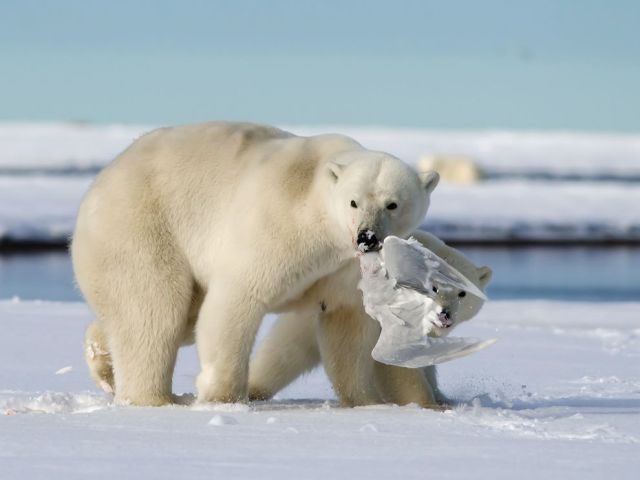
He never saw the bear. With his eyes nearly closed and snow piled onto his already-white shoulders, back and limbs, the patrol-bear was nearly invisible. The bird hopped into view, and the bear pounced. A quick swat of a massive paw, the clamp of jaws, and it was over in a moment.
“Was he really a spy?” Akrom asked. “What was he looking for? What kind of bird was he? Do they normally travel alone or in packs? Did he-”
“Flocks,” Pallaire mumbled with his mouth full of the dead spy.
“Huh?” Akrom asked, his flow of questions mercifully paused.
“Birds travel in flocks, not packs.”
Akrom was in his first week of training, and he’d been sent with Pallaire to a regularly traveled stretch of ice. Training sessions were often held in this area of the ice coast because of its relative proximity to an Arctic Defense base. Youngsters could learn the ropes without any real danger of seeing action.
Which made this seabird spy all the more concerning. If the Antarctic Alliance had sent a scout this close to a base, they were either growing too bold or too desperate. Either way, Pallaire knew it meant trouble.
“He was here to try to steal our ice, wasn’t he? My brother told me that’s the whole point of this war. North vs South, Arctic against Antarctic. It’s about ice, and snow, about keeping the cold.” Akrom was a curious mind, which Pallaire appreciated, but the lad came without a filter. That would be tamped down in training, the large bear assumed and desperately hoped.
“How do they steal the ice? Do they use boats like the humans used to?” Akrom was an unstoppable force. “I’ve never seen a southern seabird before. They look pretty much like northern ones, huh? How can you tell the difference?”
Pallaire rolled his eyes, but then stopped. He dropped the bird with a soft plop. “Where did you hear about boats? And humans?”
Akrom did not recognize the accusatory tone. “My brother,” he answered cheerily. “He’s studying at the base near the pole. He knows all sorts of stuff about the past. For example, did you know-“
“Akrom, please,” Pallaire sighed. “No more talk of humans. We have problems enough without them coming back.”
“When was the last time they came north?”
“Before my father’s time. When his father was young, I think,” Pallaire answered. He looked across the ice, saw an out-guard across a gap in the ice. He stood and waved a question – all clear? The bear responded in kind. Nothing had been spotted here.
“Grab the bird,” Pallaire instructed. Akrom nodded enthusiastically and snatched up the bird in his jaws. It was an awkward fit, and he had to adjust a few times before he really had it.
They padded down a well-worn path, vaguely in the direction of the base. But at a juncture where the base lay north, they turned east. Akrom made a sound of curiosity.
“A quick stop on the way,” Pallaire explained. They walked out across the densely packed floes, hopping from floating chunk to floating chunk. Soon they found themselves at the end of a wide channel of dark water. At the channel’s end, the open ocean beckoned.
Pallaire stepped to the edge of the ice. Lifting a paw, he slapped against the top of the water a few times. Beside him, Akrom dropped the bird and scrambled to get it back in his mouth. He missed a few times, and accidentally kicked it across the ice.
Yelping with rising panic, the young bear bounded after the skidding bird. With a remarkably deft clamp of his jaws, he grabbed it just before the bird slipped off the ice and into the water.
Inches from his nose, a massive, grinning face sprang up from the water. Akrom’s eyes went wide and he froze in place, half in awe and half in fear.
The orca bobbed with his head out of the water. Opening his grinning mouth, he let out a high-pitched click-call that sent Akrom dashing back behind Pallaire, the bird flopping wildly in his jaw. The big bear laughed as the cub sought shelter behind his bulk.
“Keiko,” Pallaire said in greeting to orca. “Fishing’s good?”
“It’s been wonderful,” the whale answered. “I see you’ve had success yourself.”
“Not the kind I’d welcome. It’s Antarctic.”
“A scout?”
The bear nodded. “Or a spy. I think it was identifying possible floes to steal.”
Keiko shook his head and let out a distressed call. “Daring thieves. We have not heard any raiding pods.”
“That’s good, but alert the other water patrols. If there are Right Whales anywhere nearby, we’ll need to know.” Pallaire lifted a thick, white paw and pointed back toward the base. “There are bears posted at the ice’s edge by the Eorec Base. If you see or hear anything, have them sound the alarm immediately.”
“Of course.” Keiko nodded and flashed another toothy smile. “My apologies for startling you, young one. You did well not to drop the bird in your fright. You’ll make a fine out-guard one day.”
Akrom leaned out from behind Pallaire, bird still in his mouth, and stared at the black and white face that bobbed in the water at the ice’s edge. The orca grinned, dipped his mouth into the water and gave a quick squirt toward the bears. Then he dropped below the water and was gone.
“Come on,” Pallaire said. “Let’s get the bird back. They’ll want to examine him. And we’ll need our rest. I imagine the patrols will increase after our adventure today.”
The two bears turned from the ocean and began the trek back toward the base. The war between their Arctic homeland and its southern nemesis was ongoing and, it seemed, unending. Battles were still left to win if there was to be a victor in the fight to control the last vestiges of the world’s cold.
 The Tall Tale Year