On the Wire – At the Edge of the World
By C. Cibo
12th Drose 1342 A.A.
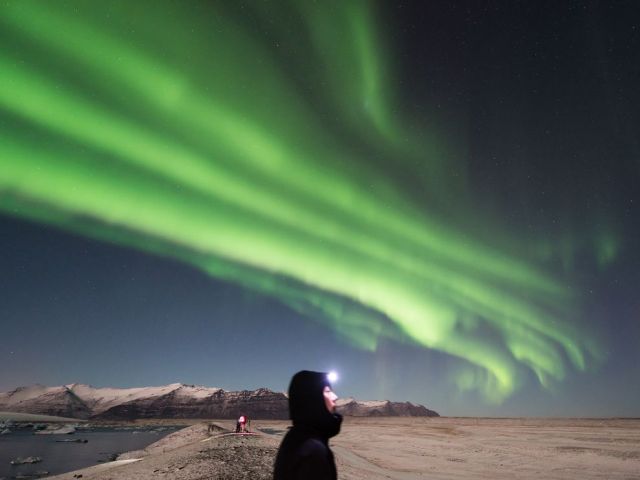
The Aurora Borealis has been known to humanity for as long as people have ventured above the Arctic Circle. All year, the green lights dance in the sky in their wavering, unpredictable way.
But something’s changing.
For the last five months, scientists have made camp in the Arctic to study an anomaly in the Aurora Borealis. Its oscillations have grown unusual. The green light seems to waver in ways that run counter to the general scientific consensus. For the last five months, the Aurora Borealis has moved in ways it should not.
The sun drives the Earth’s Auroras. Both the Aurora Borealis (northern hemisphere) and the Aurora Australis (southern hemisphere). Solar wind, which consists of charged particles released at tremendous speed from the surface of the sun, interacts with our planet’s magnetosphere. Through a little-understood process, the interaction results in the bright green or red lights known as the Northern or Southern Lights.
Instruments have been dispatched to study whether the amount of solar wind has changed in the last five months, but some scientists believe that any data from that instruments would be unrelated.
“The amount of solar wind coming from the sun would surely alter the aurora’s intensity and its coloration,” said Dr. Anyek Twes, chief planetologist at the University of Colorado. “But solar wind is always discharged in irregular patterns. It cannot account for the oscillations we’re now seeing in the Aurora Borealis.”
There’s another, less complex reason why the sun is an unlikely culprit for the phenomenon. The Aurora Australis has experienced no measurable change in its nightly light show.
“If the sun were guilty, both auroras would be modified,” Dr. Twes said. “So there must be another explanation.”
A government code-breaker believes she’s found the answer. Given access to the data gathered by scientists, she’s identified a certain regularity that could signal a code. Tucked away in a building somewhere in the capital, the unnamed code-breaker is hard at work attempting to prove her theory.
Sorme Code, the famous code used by navigators for centuries, uses a series of sound bursts, translated as dots & dashes, to send coded messages across the vast oceans. If this code theory is proven correct, it will signal that a regular message is being sent to, or from, or through the Aurora Borealis.
And if that is the case, only one thing will really matter – who is sending the message?
“Well, first off, that’s just a theory, and perhaps a far-fetched one at that,” said Dr. Twes. “Though it’s certainly exciting to think about, I wouldn’t pin our hopes on it. For one thing, that code-breaker is already through two full days of data, and no information is repeated. Repetition is the key to these kinds of codes.”
And if she comes across repetition?
“Even if she does, the most likely culprit is Earth. The refraction or deflection of a signal on the surface of the planet could somehow be affected by the magnetosphere and, therefore, revealing itself in the oscillations of the Aurora. That’s all conjecture, mind.”
Scientists will keep observing the strange phenomenon. And the rest of us will wait to see if the code-breaker has discovered some celestial message hidden in the dancing green of the Northern Lights.
 The Tall Tale Year