
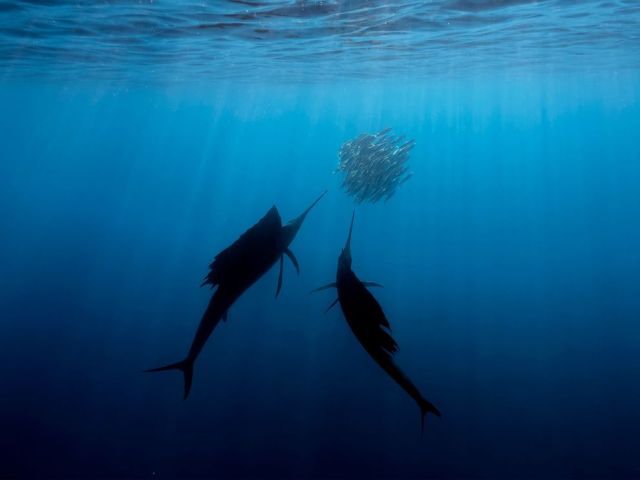
http://photography.nationalgeographic.com/photography/photo-of-the-day/sailfish-isla-mujeres-mexico/
Weak banks of fog enveloped the harbor. Up and down the wharf, the Harbormaster’s orders were barked by striped-shirted deputies. Their voices rang hollow in that strangely dull tone unique to speaking in the mist. Braziers were lit at the end of each dock. It made them look like long wooden fingers reaching into the unknown. Sailors in port, understanding fog got them off duty, filled the bars along the wharf.
In the Avalon House, a respectful crowd packed the long tables. Big mugs of crisp cider and frothy beer filled the tabletops. A guitarist played quietly in the corner, subdued versions of the classics. Among the barflies, the talk was of the upcoming sport-fishing competition. It had just been announced that morning.
At the table nearest the bar, a group of three young friends were up in arms over the competition’s grand prize.
“The Wanderess is a corvette?”
“Yeah.”
“And she’s not on the water?” Hayter asked. She was the group’s youngest member and its resident hardhead.
Vogel shook his head. “It’s not. The HM pulled it out last spring.”
“Re-outfitted?” she asked.
“Yep. All new riggings. And he had the hull inspected and reinforced along the stern.”
“Why’s the company giving it away?” asked Eber, an exceptionally tall former academic.
At the bar, a gruff old man guffawed at the question. Sitting so near, he couldn’t help but overhear the conversation from the young sailors.
“You know something we don’t?” Hayter challenged.
“A great many things,” the man replied.
“About the Wanderess?” Eber thought it wise to ease away from any Hayter combativeness as early as possible.
“Well for one thing, she’s not a corvette,” the man said. “She’s a ketch.”
“Isn’t a ketch smaller than a corvette?” Vogel asked. “She’s nearly 90 feet long.”
“Most corvettes are longer, yes, but it’s about the masts and the rigging, not the length of the hull. And 90 feet or not, the Wanderess is rigged as a ketch.” The man spoke with a gravely voice, one carved from sea spray and the snap of sails.
Vogel nodded in understanding. He was easily the most able sailors of the friends. “Naming conventions aside, she’s supposed to be a great vessel.”
“She is,” the man admitted.
“So why is the company offering it up?” Being of academic background, Eber’s curiosity was his defining feature. Defining conversational feature; there was no getting over his tall, lanky frame.
The old man chuckled. “Because the grand prize can’t be won.”
“Sure it can,” Hayter countered. “It’s catching a sailfish. They’ve been caught before.”
“Prizes can be won. Sailfish can be caught,” the old man allowed, then continued, “But the Twins, either one or the other, cannot be caught.”
Hayter blew a raspberry and waved the old man off. “Says the geriatric drinking alone at the bar.”
“We went after them three times in the days when we, too, were made invincible by the siren called possibility,” began the old man. He spoke with resolute calm and a thread of nostalgia that could not help but capture the attention of the three young friends. “We followed the Shimmering Schools, the same as you’ll do, until we saw their spines break the water nearby.
“Three times, I got the line in the water as the Twins circled their prey and, incidentally, circled us. On the first attempt, I snared the sister, Hero. She’s the faster of the pair, and she ran the line out as far as it would go, near a half-mile from the ship. We began, as a team, to reel her back toward us. When she was close, maybe thirty yards, she began to swim, hard, against the line. She pulled it taut and Leander, the brother, charged the space between us and her. He hit the line square with that tiny, sharp tip of his bill. Snapped the line easy as you like.
“After that, we figured he was the protective sort. So the second time we went after them, we purposefully got the hook into his mouth. Leander, it turned out, wasn’t like his sister. He did not flee, and he did not submit. He circled the boat while we tried to find her in the water, to keep tabs on her before we began the arduous process of dragging him to the ship. We heard a low thunk. All hands fell still. Another thunk, then another and that came paired with a little tremor. None of us could figure it out before the call came from below deck.
“Hero was ramming the ship, spearing the hull straight through. After each hole pierced in the wood, she wriggled herself free, circled down and charged back up again. We’d sprung half a dozen leaks. As we patched them, she rammed again and again, sometimes narrowly missing our feet as we attempted to stem the water that slowly filled the lowest deck.
“We cut the line and watched Leander swim free. Hero did not ram us again, and once we patched 17 holes, we limped away in defeat.
“The third, and as you know final, attempt was the mark of hubris. If we couldn’t catch just one, we figured our only chance was to catch both at once. They couldn’t defend each other if they were both on the line. A fool’s logic. I got Hero on the line, but Leander refused the other bait. Then we lost him. Like a ghost in the sea. It wasn’t until he leapt from the water with fury in his eyes that we knew our mistake. He flew, not coasted with momentum, but flew over the water toward us. He rocketed over the stern and swung his head violently, his razor-sharp bill dicing the air. I spun to the side so he could not spear me. He only just grazed me, and I thank the sea for that gift every chance I get. He vanished back into the water, and I dropped the whole rig, line, pole, all of it, into the water. As far as I know, no one’s been foolish enough to try to catch either of them since.”
For a moment, the table of young fishermen sat quietly, processing the information. Eventually, Hayter snorted and threw back the rest of her cider.
“No way that’s true,” she said and rolled her eyes. “They wouldn’t hold a contest no one could win.”
The old man shrugged and lifted his shirt. There was an old scar, a foot long and ragged, over his ribcage.
“Could be from anything,” Eber said without conviction.
“Could be,” the old man said and dropped his shirt. “Isn’t. Don’t bother with the contest. The Twins cannot be caught. And should not. The sea needs guards, and they’re as good a pair of protectors as the water could hope to have.” He turned away, back toward the bar, and said no more.
 The Tall Tale Year