
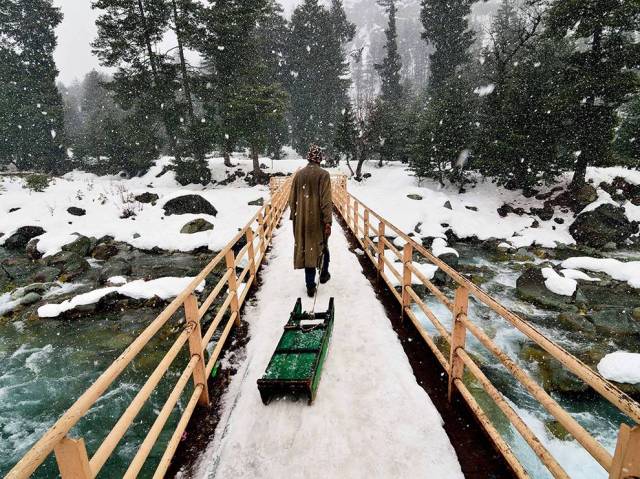
http://photography.nationalgeographic.com/photography/photo-of-the-day/man-walking-snowy-bridge/
It was the sound of the sled that got him. The half-crunch, half-slice of the dull blades meandering across the not-quite-frictionless surface. The brief absence of sound when it hit a perfect patch of ice and could glide silently for just a moment. Or maybe it was the sled’s weight. How could it be possible for an empty sled to be so much heavier than one with a rider?
He approached the bridge by midday, the same as last year. Same as the year before that. He heard it before he made the last turn, and he knew the sacrifice worked. Of course it worked. They wouldn’t do it if the God of Winter wasn’t true to his word.
When he stepped onto the bridge, he enacted his first small rebellion. Instead of looking at the ice break up, at the cold water begin to run again, he kept his head up, his eyes forward. If the God of Winter wanted satisfaction from his people, he’d have to look elsewhere.
Without looking back, the man crossed the bridge dragging his sled; its rider was lost, and spring followed with it.
“The death of winter brings the birth of spring.”
These were the last words of the priest’s blessing before the sacrifice. Before he’d dragged the sled across the snow, sweating from the effort because the sled was not empty on the way out. Before he’d left the sacrifice for the God of Winter, who would only let relinquish his icy grip on the land after the sacrifice was made. Before, he was absolved of his previous wrongs, a pure figure carrying a pure figure to a pure setting to be given to an impure god.
It was no blessing, of course. In years past, he made the trek as fast as possible. In town, the priest awaited, ready to absolve him once more. With sled in tow, his younger version saw wisdom in living between blessings as briefly as possible. It was a race, every year chasing his ghost from the year before, desperate to cut time from the preemptive cleanse to the priestly epilogue.
His justifications were impermanent. In fact, that was quickly becoming a recurring them in his life – impermanence. Women came and went, none willing to stay and marry an executioner. His childhood dog, lifelong companion, only true soulmate, had succumbed to the ravages of age a few winters earlier. Even the priest was a new one, his predecessor since returned to less treacherous prisons, a reward for good behavior.
Nothing had stayed, year from year. Winter itself always left, brought down by the willingness of the people to provide for the God of Winter.
Unless it didn’t.
He stopped at the end of the bridge. He turned and looked back, at the empty sled and the snow-streaked bridge and the opening river and the white woods beyond. All of it would change, from winter to spring to summer to autumn. From an empty bridge to a full one, white woods to green.
From God of Winter to God of Spring. But only if the people provided.
Unless they didn’t.
He made up his mind then and there. Next year, impermanence wouldn’t be a mere trend in his life, a thing he noticed when he stopped to look. It would be his mantra, his call-to-arms, his muse. He would bring the sacrifice to the bridge, but he would cross alone. No sled, no blessing, no purity for an impure god.
And perhaps winter would end anyway. Or maybe he would end. There was no telling without trying, no life without the specter of death, no progress without constant change. Perhaps, there could be no winter without spring.
Next year comes the death of winter, one way or the other.
 The Tall Tale Year