
http://photography.nationalgeographic.com/photography/photo-of-the-day/night-stars-clouds/
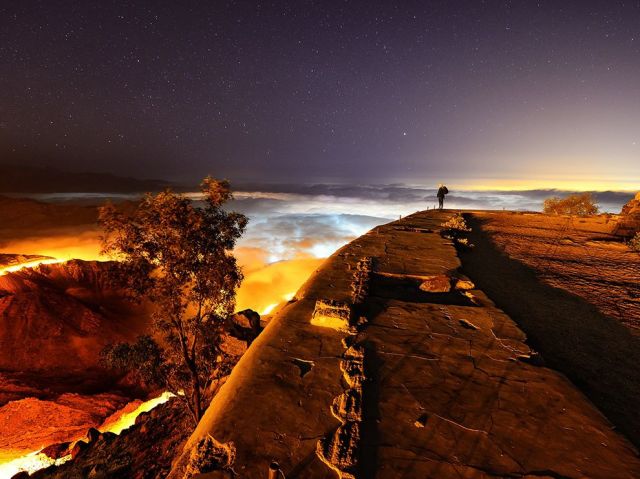
Looking down felt like looking backwards.
Backwards in Sysha’a life. She was 15 when she first came here, bussed out from her rural hometown after a wave of disease took most of her village, including her parents. She was terrified. The stories from the light farms were as varied as the colors that pulsed through the ever-present fog. But then it didn’t seem so bad, not at first. She was given a bed, a trunk, a job and the standard wage of a line sorter. One night, years later, she realized the dull walls and rotating cast of bunkmates had become familiar, and she’d started to refer to it as “home” in her inner dialogue. She’d nearly vomited from the thought. From that moment, every thought was based on planning her escape.
Backwards in her mind. Down there, hidden by the fog that always swirled around the hot lightcrops, was a quagmire. Everything moved as if out of time. Days didn’t differ from one another. Work, work, work, work, rest, work, work, work, work, rest. Repeat until time or your mind comes undone. Outside, the fog hung over everything, clung to the workers, the lightcrops, the massive harvester mechs and the squat brick buildings. Its wispy clutches were a vice from which nothing escaped; not workers, not lightcrops, not the powerful mechs, not even time itself. Sysha knew what was forward – safety and comfort and hope. Those come from change, from improvement, from effort. Down below, there is no change. Only fog and light, work and rest, life and, inevitably, whatever comes after.
Backwards in history. It was this history that had, in the end, granted her a path up from the valley. From this same plateau, thousands of years prior, advancing armies from the north were the first foreigners to set eyes on the light fields. On these plateaus, above the fog, they built an empire beside the ancient lightcrops. The polychromatic power those people harvested charged their growth, transformed them from a horde of sword-wielding maniacs to erudite, technological citizens. Their wealth came from those distant fields below, but they grew up here. Out of the valley.
Looking down from up here, Sysha understood what so many people must have felt before her. She owed a great debt to her time on the light farms. Without lightcrops, she would surely be dead by now, or nothing more than a starved orphan in a ghost town hundreds of miles from anything. When survival was the only thing she needed, these fields had provided. But they were not capable of giving more, and those that worked the light farms could not become more. Not while they stayed down there, trapped in the flashing fog.
Looking up felt like looking forward. Starlight punctured the black veil of night. Those small dots were everything the luminous crops below were not; controlled, predictable, calm pinpoints. In her old life, down in the valley, they were something to be imagined, unseen beyond the blanket of fog. But here, on the plateau, in the town where she would soon take up residence, they were a fixture of the night. And the stars had beauty, maybe only seen to her; organized into constellations of a life, with a home and a husband and people who care if she comes home at night.
She turned from the sprawling view of her old life and walked away from the farms, from the life of loss in which she’d been trapped for too long. The lightcrops flashed a spectacular farewell, or they hardly noticed at all. Sysha didn’t mind either way. She didn’t have to look down, look backwards, look forlorn. Not anymore. These lights would always be behind her, there was no denying that. But for the first time since her parents died, she finally saw a light up ahead.
 The Tall Tale Year