
http://photography.nationalgeographic.com/photography/photo-of-the-day/india-boy-calf/
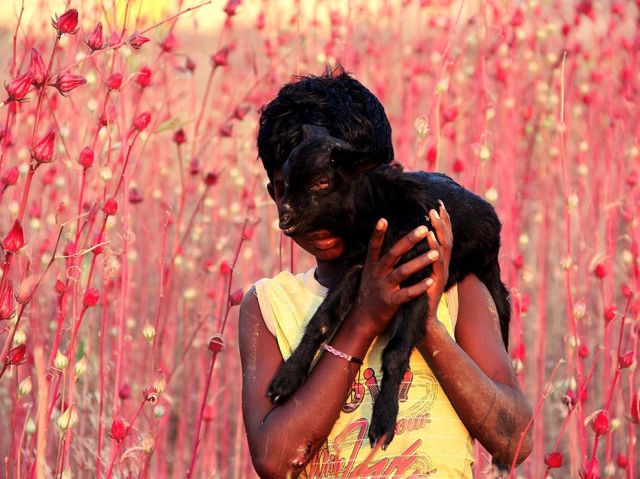
Whispers and hushes rustled through the small auditorium like a wind washing over a field of golden crops. Slowly, in a simple pattern, the university students turned their attention forward and down. On the big wall at the front of the room, an image of a child holding a black goat had clicked onto the screen. Standing before it, the professor waited patiently for the pattern of quiet to run to its conclusion. Soon, calm settled over the classroom.
“Beauregarde Goats. Any of you that have taken other agribusiness classes will have heard of them. Early Mesopotamian cultures husbanded goats at the dawn of civilization, and it’s believed the earliest forms of the Beauregarde Goat were developed there. The French name is tied to their eventual popularity in the south of France where the endless lavender fields provided the catalyst to their growth as a worldwide cash crop, as it were.
“Beauregarde Goats have a genetic pigmentation structure unique in the animal kingdom. The fluid nature of their coat color is not, in itself, unique. Certain cat breeds, like the Tonkinese, will take on range of coat colors based on the climate of their home. Arctic foxes and hares, as well as ermines, all have a white winter coat and a more colorful, brown or tan summer coat. But all of these have a range of coats in which they must operate. Their DNA, as it must, instructs the coat what color to be.
“Not so with the Beauregarde Goat. These goats have DNA instructions that are much less formal. They tell the fur to become a color based on what the animal eats. The more standard diet, the more standard the color – these are your fawns, tan, white, and black. But the more specialized the diet, the more specialized the goat’s fur will become. And so did the textile industry in Gaul, when the Romans ruled the world, blossom.
“During the days of Rome’s rule, the legions discovered enormous flocks of purple and blue goats in the southern reaches of Gaul, in what is now the Provence region of France. It was quickly established that the goats’ fur was affected by their diet which entailed eating a great deal of lavender flowers. When goats were taken from the heard and fed standard cereal grains, their coats eventually shook off the fashionable tinge for a more traditional black.
“Fast-forward a couple thousand years, and Beauregarde Goats are a staple of livestock herds throughout the developing world. Their polychromatic wool is a cheap way to develop high-quality mohair, used in textiles from one corner of the globe to the other. For many people, they are the major, and really sole, revenue source in their lives. They are the membrane between a life of modest means, not comfortable but livable, and abject poverty.
“And this importance creates an enormous strain around the Beauregardes. Fields that were once rotated regularly, laid fallow, are now strictly regulated to grow certain types of crops. These are feed crops, each used to generate a predictable amount of mohair in specific hues. Chemicals and industrials fertilizers are used to charge the land, at the cost of the long-term viability of the soil. Predator animals, wolves and coyotes, hyenas and mountain lions, and many others, are killed by the dozens and by the hundreds, all in the name of saving the Beauregarde flocks. It’s an awesome bubble, and it’s only a matter of time before it pops.
“We’re going to move on to some other topics around third-world husbandry. But there are a few articles I’ve posted on the class site about the Beauregarde Goats, and a bibliography of other recent writings including Dene Gepp’s book on the Beauregarde economy on the Indian subcontinent which is where I got this image. A young boy holding up his only hope, seeming to look out through the goat’s own face at a world that could change, in the blink of an eye, from difficult to impossible.”
 The Tall Tale Year